A missing CTO rarely feels like a single, dramatic failure. It shows up as small, daily frictions that slowly reduce your team’s speed, confidence, and focus.
If you’re in this situation now, you’re not alone. Many organizations have a “CTO-shaped gap” for a season: a founder who stepped back from the code, a CTO who left unexpectedly, a business that outgrew its early architecture, or a leadership team that needs time to hire the right person.
The good news: you can stabilize quickly, protect delivery, and even make the next CTO hire easier if you treat this like an operating problem (not a hero problem).
The CTO seat is more than a title
A CTO is not just the most senior engineer. The role is a clearinghouse for decisions that can’t be postponed forever, such as:
- What “good” looks like in engineering (quality, reliability, security, velocity)
- How to balance roadmap work vs. tech debt vs. platform investments
- What to build, what to buy, and what to stop doing
- How engineering aligns to business goals and constraints
When that decision hub disappears, the work doesn’t. It just spreads out across the organization, often in messy ways.
The first 30 days without a CTO: the hidden costs
In the early phase, many teams “seem fine.” The sprint still runs. Incidents still get resolved. Features still ship.
Then the cracks appear.
Priorities start to drift (and nobody owns the tradeoffs)
Without a CTO, prioritization can quietly become a negotiation between whoever has the most urgency, the loudest stakeholder, or the biggest customer escalation. Engineers end up context-switching, while product plans lose shape.
You might hear:
- “We’re not sure what’s most important this quarter.”
- “We keep starting, but we don’t finish.”
- “Everything is a P1.”
Architecture becomes a series of one-way doors
Every team makes architectural tradeoffs. The CTO’s job is to make sure those tradeoffs are intentional, documented, and revisited.
Without that, small “temporary” decisions stack up: quick integrations, rushed schema changes, inconsistent service boundaries, and unclear ownership. It works—until it doesn’t.
Standards become personal preferences
Code review styles diverge. Testing expectations vary by squad. Release practices become inconsistent. Observability is “nice to have.”
This is how you get two teams building the same capability in different ways, and neither is wrong—yet both create long-term drag.
Hiring slows down, even if recruiting is “active”
Many candidates want clarity on:
- Technical direction
- Career progression
- How decisions are made
- How engineering partners with product and leadership
Without a CTO, the message gets fuzzy. Good candidates hesitate. Great candidates opt out.
Security and compliance become risky by default
If no one owns the security posture, you can end up with “best effort” practices, unclear accountability, and late surprises—especially if you operate in regulated environments.
Delta Systems explicitly calls out experience with security-driven workflows and standards like HIPAA and ADA web standards, which is often where leadership gaps hurt the most.
The second-order effect: your engineering leads get overloaded
In a CTO vacuum, strong engineering managers and tech leads often try to “cover” leadership work on top of their existing responsibilities.
That creates a predictable pattern:
- Leads spend more time in meetings and escalations
- Deep work shrinks
- Decisions slow down
- The team relies on a few people
- Those people burn out (or leave)
Even if you keep shipping, you’re quietly spending your best leadership capacity on triage.
How to tell if you have a CTO gap (a quick diagnostic)
Use this as a fast gut-check. If you answer “no” to several items, you’re likely operating without effective CTO coverage.
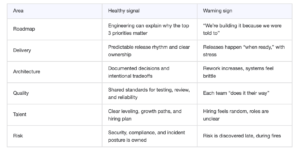
A rushed hire is expensive. It can also set you back months if the fit is wrong.
A better approach is to stabilize the operating system of engineering first.
Step 1: Assign decision ownership (even if it’s temporary)
Pick one accountable owner for each of these:
- Technical direction and architecture decisions
- Delivery and release health
- Security posture and risk review
- Hiring process and leveling consistency
This can be a small “engineering leadership council,” but it needs a single tiebreaker.
Step 2: Reduce the decision load with lightweight governance
You don’t need heavy process. You need repeatable clarity.
Examples that work well:
- A weekly 30-minute architecture review for “one-way door” changes
- A simple RFC template for significant decisions
- A shared definition of done (tests, monitoring, rollout expectations)
- A release checklist that prevents last-minute chaos
Step 3: Create a 90-day technical narrative
If you want to hire a CTO (or even a VP of Engineering), you’ll attract stronger candidates when you can clearly explain:
- What you’re building
- What’s working
- What’s broken
- What tradeoffs you’ve already made
- What the next leader will own in the first 6 months
This also stops internal debates from restarting every two weeks.
If your team is already feeling the pain, treat this as an execution risk—not just an org chart issue. The longer the gap lasts, the more your roadmap turns into maintenance.
A practical 30/60/90 plan to stabilize engineering without a CTO
0–30 days: stop the bleed
Focus on consistency and focus.
- Freeze (or limit) major architectural changes unless reviewed
- Simplify priorities to a small, clear “now” list
- Make releases boring again: fewer surprises, clearer ownership
- Capture tribal knowledge in a shared place
31–60 days: restore momentum
Now you can improve the system.
- Establish shared standards (testing, reviews, deploys, incidents)
- Identify your top 3 sources of delivery drag (and remove one)
- Audit the “risky unknowns” (security gaps, brittle integrations, aging infrastructure)
61–90 days: prepare for the next leader (internal or external)
By this point, you’re building leverage.
- Define the target role clearly (CTO vs. VP Engineering vs. Head of Product Engineering)
- Build a hiring scorecard and interview loop
- Turn the technical narrative into onboarding material
When an external partner can help (without replacing your CTO)
Sometimes you don’t need “a CTO.” You need CTO outcomes for a season:
- Clear technical direction
- Reliable delivery
- Healthier legacy systems
- Faster iteration without reckless rewrites
Delta Systems is an on-demand development partner that can embed with teams to design, build, and modernize web apps, mobile apps, APIs, and data systems—without rigid contracts or bloated processes.
We also highlight work that often becomes urgent during leadership gaps: scaling or rewriting legacy software, complex B2B SaaS builds, long-term product maturation, and tricky third-party integrations.
If you’re evaluating whether to hire a CTO or lean on a delivery partner while you stabilize, Delta Systems has a helpful breakdown you can use as a starting point.
What “help” should look like during a CTO gap
The outcome you want: calm delivery and confident decisions
Your engineering team can absolutely succeed without a CTO—for a while.
But if you want sustainable velocity, you need someone to own the decisions that shape the system: priorities, architecture, standards, risk, and talent.
If you’re in the middle of this transition and want a steady hand, Delta Systems offers a “no sales fluff” conversation to explore how we can plug into your team.