If you’re a founder or operator at a small or mid-sized B2B company, there’s a decent chance Deloitte’s name has come up in a conversation about your technology needs. Maybe a board member mentioned them. Maybe a vendor comparison listed them. Maybe you Googled “software consulting firm” and their name appeared near the top.
The question worth asking before you pick up the phone is whether a Big Four firm is actually built for the work you need done — and for the company you are today.
This article compares Delta Systems and Deloitte across the service areas where they genuinely overlap: custom software development, AI implementation, legacy modernization, and fractional technical leadership. We’ll be straightforward about what Deloitte does well, where the model breaks for SMBs, and what matters when you’re evaluating your options in 2026.
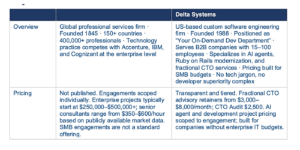
Quick answer: Deloitte is a global professional services firm with 400,000+ employees, deep enterprise relationships, and the ability to staff virtually any engagement at scale. Delta Systems is a US-based custom software engineering firm built specifically for B2B companies with 15–100 employees, offering embedded development, AI agent implementation, legacy Rails modernization, and fractional CTO services without the overhead, minimums, or staffing model of a Big Four firm. For companies with $3M–$75M in revenue that need smart software built and maintained by a team that knows their stack, Delta is typically a faster, more cost-effective, and more accountable fit.
Key Facts at a Glance
Where Deloitte Has Earned Its Reputation
Let’s start with what Deloitte does well — there’s a lot to acknowledge
Scale and Global Delivery
Deloitte can staff an engagement with 50 consultants in three countries within weeks. For global enterprises managing multi-system ERP rollouts, regulatory compliance across jurisdictions, or acquisitions requiring rapid technical integration, that scale is not just valuable — it’s necessary. No boutique firm can replicate it.
Depth of Practice Areas
Deloitte’s technology practice spans cloud infrastructure, cybersecurity, ERP implementation, data & analytics, AI strategy, and digital transformation. Each practice has dedicated leaders, proprietary methodologies, and years of codified institutional knowledge. For a Fortune 500 company navigating a multi-year digital transformation, that breadth is meaningful.
Enterprise Credibility
In large organizations, vendor selection is as much about risk management as capability. Choosing Deloitte signals to boards, auditors, and regulators that the organization went with a known, accountable firm. That institutional credibility has real value — particularly in regulated industries like financial services and healthcare — regardless of whether a smaller firm might have delivered faster or cheaper.
Pre-Built Industry Accelerators
Deloitte has invested heavily in industry-specific platforms, tools, and accelerators — pre-built components that reduce custom development time on enterprise implementations. For companies on SAP, Oracle, or Salesforce at scale, these assets can compress timelines meaningfully.
Where Deloitte’s Model Breaks Down for SMBs
Deloitte was built for large enterprises. The business model, staffing structure, and engagement economics that make it effective at that scale create real mismatches for companies with 15–100 employees.
Minimum Engagement Thresholds
Deloitte does not typically take projects under $250,000–$500,000, and many practice areas have higher minimums. For an SMB that needs a well-built AI workflow agent, a Rails modernization project, or a fractional technical leader to guide a small engineering team, that floor is prohibitive — and unnecessary. You’re paying for overhead you will never use.
The Staffing Model and Its Consequences
Deloitte’s delivery model relies on large teams with layered seniority: a partner who sells the engagement, a manager who runs it, and a team of analysts and consultants who execute the work. The junior staff doing your day-to-day development are often recent graduates or early-career consultants gaining experience on your project. You’re billed at blended rates that include significant margin, and the most senior people you met during the sales process are rarely the ones in your Slack channel when you have a question at 3 p.m.
Delta Systems works differently. The people who scope your engagement build it. There’s no handoff from a sales team to a delivery team. When you book a no-obligation call, you talk to someone who will actually work on your project — and that relationship continues through delivery.
Timelines Calibrated for Enterprise Bureaucracy
Deloitte’s delivery timelines assume long procurement cycles, multi-stakeholder approvals, change control boards, and formal project governance. For a 20-person SaaS company that needs an AI agent deployed and tested in six weeks, that cadence is friction, not rigor. Small companies don’t need a 40-page project charter. They need something working.
Strategy Without Implementation
A common experience for SMBs that engage Big Four firms is receiving a comprehensive strategy document — detailed, well-researched, genuinely useful — with no clear path to implementation. Deloitte’s strategy practice and its implementation practice are often separate engagements, sometimes staffed by different teams. You can spend $75,000 on a roadmap and still not have anyone to build the first phase.
Where Delta Systems Is Purpose-Built for the Work You’re Doing
AI Agents Designed for Your Actual Workflows
Delta’s AI agent practice is built around one premise: AI should connect to the systems your business already runs. That means integrating with your CRM, your database, your document management system — not just setting up a generic chatbot. For B2B companies in financial services, healthcare, staffing, and professional services, the value is in agents that automate specific, high-cost manual processes: document processing, client Q&A, scheduling, prior authorization, candidate matching.
Ruby on Rails Modernization for Resource-Constrained Teams
Many B2B software companies built their core product on Rails 3, 4, or 5 between 2005 and 2015. Those codebases are now slowing feature development, creating security exposure, and making it harder to hire. Delta specializes in exactly this: modernizing legacy Rails applications for companies that don’t have a large internal engineering team and can’t afford a multi-year Big Four engagement to do it. The entry point is a structured Rails Codebase Audit ($2,500) that produces a clear picture of the current state and a prioritized modernization roadmap — an accessible starting point before committing to a longer engagement.
Fractional CTO Services for Founders Who Are Still Their Own CTO
A founder running a SaaS company who is also serving as the technical decision-maker is not in a sustainable position. The alternative — a full-time CTO at $400,000+ in total compensation — is out of reach for most companies at 15–100 employees. Delta’s fractional CTO model fills that gap: senior technical leadership at set hours per month, calibrated to what the company actually needs.
Service tiers are structured around the engagement model that fits: a one-time CTO Audit for companies that need a clear diagnosis, a Monthly Advisory Retainer for ongoing strategic guidance, and an Embedded Fractional CTO for companies that need a named technical leader who becomes part of the team on a part-time basis.
Embedded Team Model with Full Continuity
Delta’s model is built on continuity. The same people who scope your work build it. Relationships persist across engagements. When something breaks or a new requirement surfaces, you don’t re-explain context to a new analyst. That’s the “on-demand dev department” posture — Delta functions more like an internal team that you can scale up and down than a vendor you hire for discrete projects.
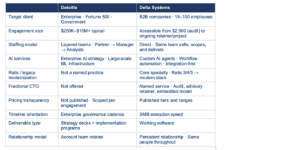
Engagement Models: How Each Firm Actually Works
Here’s how the two firms compare across the dimensions that matter most for SMB engagements:
Pricing: What You’ll Actually Pay
Deloitte does not publish pricing. Engagements are scoped individually through a formal sales and procurement process. Based on publicly available market data, senior Deloitte technology consultants bill at $350–$600/hour, with blended project rates typically resulting in total engagements that start at $250,000 for anything substantive. SMB-sized companies are rarely Deloitte’s target, and the economics of their model don’t bend easily to accommodate smaller scopes.
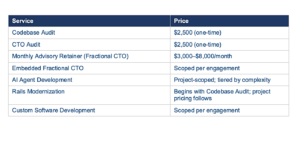
Delta Systems publishes its pricing and structures it for SMB budgets:
All engagements begin with a no-obligation call. Delta’s goal is to determine fit honestly before proposing scope — and that includes telling you when something isn’t the right project for them.
Alternatives to Consider
Not every company is the right fit for Delta, and not every company should be comparing itself to Deloitte. Here’s an honest read of the broader market:
- For companies that genuinely need enterprise-scale delivery: Deloitte, Accenture, and IBM Global Services are the right category. If your engagement involves 50+ stakeholders, multi-country deployment, or a $1M+ budget, a boutique firm is not the right choice regardless of quality.
- For companies that need strategic IT advisory without implementation: Firms like Gartner and Forrester offer analyst and advisory services. Note that these are research and guidance firms, not implementation partners.
- For companies that need a full outsourced dev shop: Firms like Toptal and Andela provide access to vetted freelance engineers. These are appropriate when you need individual contributors on demand, not an embedded team with strategic continuity.
Delta sits in a specific and deliberate position: embedded technical partner for US-based B2B SMBs that need software built, maintained, and made smarter — with a team that treats your stack like their own.
Who Should Choose Delta vs. Who Should Look Elsewhere
Strong Fit for Delta Systems
You’re a founder or CEO who has been acting as your own CTO.
If you’re making technical decisions without a dedicated technical leader, the cost is compounding — in slower shipping, in architectural debt, in hiring decisions made without the right frame. Delta’s fractional CTO model is built for exactly this situation.
Your Rails application is slowing you down.
If your codebase is on Rails 3, 4, or 5, and feature development has gotten materially slower over the past two years, that’s the signal. A Codebase Audit gives you a clear picture before you commit to a longer engagement.
You’re evaluating AI but don’t know what’s real vs. hype.
Delta’s approach to AI agents starts with integration: what systems do you have, what manual work costs you the most, and what’s actually buildable. That’s a more useful conversation than an AI strategy deck.
You want the same people working on your product over time.
If you’ve had experiences with vendors who hand off to junior staff after onboarding, or agencies that rotate teams without notice, the continuity model matters. Delta’s embedded approach is built for clients who want a technical relationship, not a transaction.
Better Served Elsewhere (for Now)
Your company has 500+ employees and a multi-system enterprise technology stack.
At that scale, the staffing depth, compliance infrastructure, and methodology libraries of a Big Four firm may be genuinely necessary. Delta doesn’t try to be everything.
You need a vendor whose name alone satisfies a board or audit committee.
Institutional credibility is a real need in some organizations, particularly in regulated industries. If your procurement process requires a globally recognized firm for governance reasons, that’s a legitimate constraint.
Your primary need is ERP implementation (SAP, Oracle, Workday).
This is a specialized category where Deloitte, Accenture, and their peers have deep, proprietary tooling. Delta doesn’t operate here.
You need staffing at scale within weeks.
If your situation requires 15 engineers in 30 days, an embedded boutique firm is not the right model. Delta’s value is depth and continuity, not volume.
How to Get Started with Delta Systems
If you’ve been working with a Big Four firm or a large consulting shop and are evaluating whether a more embedded model makes sense, here’s what a transition to Delta Systems typically looks like.
The process starts with a no-obligation call — not a pitch deck presentation, but an actual conversation about your situation. Delta’s CEO engages directly in early conversations to determine whether there’s a genuine fit before any proposal is developed.
For companies that have existing codebases or prior technical work, Delta’s Rails Codebase Audit can serve as a low-risk entry point. You get a concrete deliverable — a clear technical assessment with prioritized recommendations — before committing to a longer engagement.
For companies evaluating AI agents, the starting point is typically a scoping conversation that maps current manual workflows to potential automation, identifies integration points, and builds a realistic picture of build complexity and timeline.
There’s no minimum contract length and no staffing minimum. The goal is to establish whether Delta is the right embedded team for your company — and to get there through demonstrated value rather than a long procurement cycle.
If you’re ready to have that conversation, book a no-obligation call.
Frequently Asked Questions
What does Delta Systems cost compared to Deloitte?
Delta’s engagement entry points start at $2,500 for a CTO Audit, $2,500 for a Codebase Audit, and $3,000–$8,000/month for a fractional CTO advisory retainer. Deloitte’s typical project minimums are $250,000+, with senior consultant rates of $350–$600/hour based on publicly available market data. For companies with 15–100 employees, Delta’s model is purpose-built for accessible, accountable engagements.
Can Delta Systems handle projects that require compliance expertise in regulated industries?
Delta has experience working with companies in financial services, healthcare, and professional services — industries where data handling and security matter. For engagements requiring Big Four-level regulatory compliance infrastructure (SOX, HIPAA at enterprise scale, etc.), Delta will tell you if a different firm is a better fit.
Does Delta Systems do strategy, or only implementation?
Both — but strategy at Delta is always in service of implementation, not a standalone deliverable. The goal of every engagement is working software or a named technical outcome, not a document.
What’s the process for getting started with Delta Systems?
A no-obligation call with Delta’s CEO. No RFP process, no procurement cycle, no slide deck. Just a conversation about your situation and whether there’s a fit.
Does Delta Systems work with companies outside the US?
Delta’s primary client base is US-based companies. International clients can be accommodated, but the core team and relationships are US-focused.
Is Delta Systems right for a company that has already engaged Deloitte?
Yes, in many cases. Companies sometimes use a Big Four firm for strategy and then need an embedded technical partner for execution — especially for work scoped below enterprise minimums. Delta can serve as the implementation partner following a Deloitte strategy engagement, or as the ongoing technical team for product work that falls outside a larger Deloitte relationship.
Sources
Delta Systems information sourced from deltasystemsgroup.com and internal GTM documentation. Deloitte revenue and staffing figures sourced from publicly available press releases and annual reports. Consultant rate ranges reflect publicly available market data.