If only one developer can safely touch the most critical parts of your legacy system, you do not just have technical debt. You have operational risk.
This situation is common in growing B2B software teams, especially when the codebase has survived years of urgent fixes, team turnover, and shifting priorities. It can feel manageable right up until that one person takes PTO, gets sick, changes roles, or leaves.
The real problem is the bus factor, not the code
A legacy codebase becomes dangerous when knowledge about it is trapped in one head. This is sometimes called the bus factor or truck factor: how many people can disappear before progress stops.
When the bus factor is one, the business starts making decisions based on staffing constraints instead of customer value. Roadmaps get quieter, releases slow down, and every change feels like a gamble.
How it shows up day to day
You may already recognize the signals:
- Pull requests wait for a single reviewer because no one else trusts themselves to approve changes
- On call escalations repeatedly route to the same person
- New hires take months to become productive because onboarding depends on tribal knowledge
- Simple changes take days because the risk of unintended side effects is high
One important nuance: a legacy codebase is not automatically bad. Many legacy systems are profitable and stable. The risk is the combination of complexity plus concentrated knowledge.
Why this needs to change now, not later
Teams often delay fixing knowledge bottlenecks because it feels like overhead. But the cost compounds.
1) Delivery slows in quiet ways
Work expands due to uncertainty. Engineers over test manually, avoid refactors, and ship smaller changes than the business needs. Over time, lead time grows even for small updates.
2) Incidents take longer to resolve
When only one person understands a subsystem, you lose parallelism during an outage. Even with good intentions, everyone else becomes a messenger, not an operator.
3) Retention and morale suffer
The person who knows everything becomes overloaded. Everyone else feels blocked. Both sides burn out, just in different ways.
4) Valuation and due diligence risk increases
If you ever plan to sell, raise, or merge, concentrated system knowledge increases perceived risk. Buyers and investors notice when critical systems depend on one individual.
What to change, in what order
You do not need a massive rewrite to fix the bus factor. You need an intentional plan to turn implicit knowledge into shared assets.
Step 1: Identify the knowledge hotspots
Start with a short mapping exercise:
- Which modules cause the most fear during changes
- Which workflows are hardest to explain to a new engineer
- Which integrations are fragile or poorly understood
- Which areas have the most production incidents
Step 2: Build safety before speed
The fastest way to share ownership is to make changes safer. Common high leverage improvements include:
- Adding test coverage around critical paths
- Creating repeatable local setup and environment parity
- Reducing hidden side effects and unclear boundaries in core flows
Step 3: Replace hero workflows with team workflows
This is where knowledge transfer becomes real:
- Pairing sessions focused on a single subsystem
- Rotating on call with deliberate shadowing
- Regular codebase walkthroughs with recorded notes
- Short runbooks for recurring incidents and deploy steps
Step 4: Standardize patterns and reduce one off conventions
Legacy codebases often have many micro patterns that only make sense historically. Consistency is a force multiplier for onboarding and review quality.
A quick way to prioritize: risk vs effort table
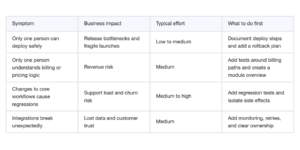
Sometimes the bus factor problem is not just documentation. The system may be so tightly coupled that it is hard for anyone to learn safely.
That is where targeted modernization helps. Delta Systems focuses on scaling and rewriting legacy software, complex B2B SaaS builds, and long term product maturation and maintenance, often by embedding with internal teams to move faster and more sustainably.
If your stack includes Ruby on Rails, Delta Systems has also published practical guidance on reducing knowledge bottlenecks by improving clarity through documentation, consistent patterns, and better test coverage around critical paths.
What success looks like in 30 to 90 days
A realistic near term goal is not perfect documentation. It is shared confidence.
In 30 days, aim for:
- Two people who can safely operate each critical subsystem
- A documented deploy checklist and incident basics
- Tests around the most expensive failure paths
In 60 to 90 days, aim for:
- Reduced review bottlenecks in key areas
- Faster onboarding for new engineers
- A clear modernization backlog tied to business outcomes
How Delta Systems can help
If you want to reduce the single point of failure risk without derailing feature delivery, Delta Systems can plug into your team as an on-demand development partner, helping you modernize, stabilize, and transfer ownership in a structured way.
You can also learn more about how Delta Systems approaches legacy modernization here.