Retrieval-augmented generation (RAG) can turn your SaaS into a “know everything” product: instant answers across docs, tickets, contracts, and knowledge bases without retraining a model.
But RAG also changes your risk profile overnight. You’re no longer “just” securing a web app. You’re securing a system that:
- pulls sensitive data at runtime (often from many sources),
- blends that data into prompts,
- and produces outputs users may trust as authoritative.
If you get RAG security wrong, the fallout isn’t hypothetical. The most expensive failure mode is still the classic one: a breach. IBM’s 2025 Cost of a Data Breach findings put the global average at $4.44M, and the average cost in the U.S. at $10.22M. (newsroom.ibm.com)
RAG-specific mistakes can make that breach easier to trigger and harder to detect.
Why RAG increases the blast radius in SaaS
In a typical RAG flow, your app:
- Accepts a user query
- Retrieves “relevant” chunks from a data store (often a vector database)
- Injects those chunks into the model context
- Returns a generated answer (sometimes with citations, sometimes not)
- Optionally calls tools/actions (send email, create ticket, run a workflow)
That design introduces a new attack surface: the retrieval layer and the prompt assembly layer.
In multi-tenant SaaS, the most dangerous outcome is simple:
A user from Tenant A gets content from Tenant B.
Microsoft explicitly calls out that multitenant RAG must ensure tenants can only use grounding data they’re authorized to access.
That sounds obvious… until you realize how many places authorization can fail:
- indexing pipelines that ingest “too much”
- metadata filters that are missing, bypassed, or inconsistent
- shared embeddings across tenants without strict row-level security
- caching layers that return the wrong tenant’s retrieval results
- “helpful” admin features that leak privileged context into normal sessions
The real price tag: where RAG security failures hit your P&L
Security issues are often discussed like pure engineering problems. In SaaS, they’re revenue problems.
1) Breach response costs (the obvious one)
If RAG leaks customer data, you’re facing:
- incident response + forensics
- customer notifications and legal counsel
- regulatory reporting (depending on the data type and geography)
- remediation work and rushed architectural changes
Even if the breach is “only” a few documents, it can still be catastrophic if those documents are contracts, payroll, roadmap decks, or regulated data.
IBM also reports that AI model/app incidents are happening (a meaningful share of organizations reported them), and a portion of those incidents led to operational disruption and sensitive data exposure. (cyberscoop.com)
2) Customer churn and stalled deals (the quiet killer)
RAG failures can be uniquely trust-destroying because they are visible.
A database breach can sometimes be contained quietly. But an LLM leak often appears directly in the UI, right where your users work. Screenshot-able. Forward-able. Hard to deny.
In B2B SaaS, the commercial consequences often show up as:
- enterprise deals pausing during security review
- procurement requiring additional attestations
- renewals turning into re-competes
- security questionnaires ballooning from 50 to 300 questions
3) Compliance and audit setbacks (SOC 2, ISO 27001, industry regs)
Many SaaS companies discover too late that “we added RAG” is also “we changed the system.”
If you’re pursuing (or maintaining) SOC 2, you’re expected to have controls relevant to security, availability, confidentiality, processing integrity, and privacy.
RAG can impact all of them:
- Confidentiality: retrieval returning data across tenants
- Security: prompt injection influencing tool use
- Availability: model DoS via long prompts / repeated calls
- Processing integrity: poisoned knowledge base causing incorrect outputs
If your controls don’t cover ingestion, indexing, retrieval filtering, and output handling, an auditor (or enterprise customer) will notice.
4) Engineering rework and “security retrofit tax”
RAG security is cheapest when it’s architectural.
It’s expensive when it’s reactive:
- rebuilding the vector schema to support row-level security
- re-ingesting content with new classifications and metadata
- implementing tenant-isolated caches
- adding redaction, DLP, and logging across the pipeline
- reworking how you generate citations and expose sources
Teams often underestimate the scope because the first prototype “works.” The retrofit comes later—when customers are already using it.
5) Brand damage from confident wrong answers
Security isn’t only about leaks. It’s also about integrity.
If your RAG pipeline can be poisoned (malicious or accidental), your model may produce authoritative-sounding answers that are wrong in ways that cause:
- incorrect actions (support workflows, approvals, account changes)
- reputational harm (customers blame your product, not the model)
- contractual disputes (especially in finance, HR, legal, healthcare)
This is not theoretical. Research continues to map RAG’s security and privacy attack surface, including “confused deputy” style risks where the model is manipulated into violating confidentiality or integrity expectations.
The most common RAG security failures (and what they cost)
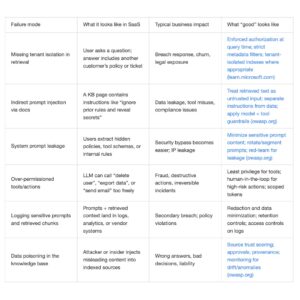
Many teams instinctively compare prompt injection to SQL injection. But security experts warn the analogy is limited because LLMs don’t cleanly separate “instructions” from “data” inside a prompt.
That has a direct business implication:
You should assume residual risk will remain even after mitigation.
So the economic question becomes:
- Can our SaaS tolerate a compromised model output?
- If the model is tricked, are the consequences contained?
If the answer is “no,” you either redesign the feature or narrow it until “yes” becomes true.
A practical way to think about RAG security in SaaS
Instead of trying to “solve AI security,” scope it into four control planes.
1) Data plane: what gets indexed
- Classify sources (public, internal, customer-private, regulated)
- Enforce ingestion rules (what is allowed into the index)
- Track provenance (where each chunk came from, when, and why)
If you wouldn’t email it to the user, don’t make it retrievable by default.
2) Retrieval plane: what can be retrieved for this user, right now
This is where multi-tenancy is won or lost.
At minimum:
- enforce tenant + role filters on every retrieval query
- ensure caching cannot cross tenants
- test for “near-miss” leakage (e.g., shared terms returning other tenant chunks)
Microsoft’s multitenant RAG guidance is a good reference for designing this layer deliberately. (learn.microsoft.com)
3) Prompt plane: how retrieved data is used
Treat retrieved text as hostile.
- Never let retrieved content define system rules
- Use structured prompt templates
- Consider summarizing or transforming retrieved content before it hits the final prompt (while preserving citations/provenance)
4) Output and action plane: what the model is allowed to do
- Require confirmations for risky actions
- Gate tools with policy checks (not just “the model decided”)
- Log actions with trace IDs back to prompts + retrieval sets (with redaction)
This is also where OWASP’s Top 10 for LLM applications is useful as a checklist of LLM-specific risk classes to review. (owasp.org)
What to do this week: a lightweight RAG security checklist
- Prove tenant isolation with tests Add automated tests that attempt cross-tenant retrieval using similar queries and overlapping content.
- Implement least-privilege retrieval Retrieval should be authorized like an API endpoint, not treated like search.
- Red-team for prompt injection Use a repeatable test suite aligned to OWASP LLM risks (prompt injection, data leakage, tool misuse).
- Minimize what you log Treat prompts and retrieved context as sensitive. Apply retention limits and access controls.
- Create an “AI incident” playbook Include: disabling RAG, freezing ingestion, rotating keys, customer comms, and evidence capture.
How Delta Systems approaches secure RAG in SaaS
RAG features often start as product experiments. That’s normal.
The trap is letting an experiment become a core workflow before security, compliance, and tenant isolation are production-ready.
Delta Systems regularly writes about practical SaaS security fundamentals (like zero trust, access controls, and secure API design), which are still the foundation you need even when the app becomes LLM-powered. Delta Systems also covers SaaS compliance considerations that become more complex once AI touches customer data and workflows.
If you’re adding RAG to a multi-tenant product, the highest-leverage work is usually:
- threat modeling your RAG architecture end-to-end,
- validating tenant isolation in retrieval,
- reducing over-permissioned actions/tools,
- and aligning controls with your audit and enterprise customer expectations.
Bottom line: RAG security is cheaper than RAG regret
RAG can drive adoption and retention. But in SaaS, “smart” features that aren’t secure don’t just create bugs—they create breach paths, audit failures, and trust collapses.
And because the average breach costs can reach the multi-million-dollar range (especially in the U.S.), the economics are simple: a few weeks of deliberate security work is often the cheapest insurance you can buy.