Legacy software rarely “breaks” all at once. It erodes quietly, release by release, until your team is spending more time protecting the system than improving the business.
If you’ve been telling yourself, “It still works, so we’ll leave it alone,” this article is for you. We’ll unpack the costs that don’t show up in a single line item, but absolutely show up in your roadmap, your customer experience, and your risk profile.
At Delta Systems, we regularly embed with teams to modernize complex web apps, mobile apps, APIs, and data systems—especially the codebases other firms avoid.
Legacy code isn’t “free” just because it already exists
A legacy codebase can look stable from the outside:
- Customers can log in
- Payments go through
- Reports generate
- Nothing is on fire (today)
But stability is not the same as health. Many organizations are paying “legacy tax” in the form of slower delivery, higher defect rates, and growing operational anxiety without realizing it.
The most expensive legacy systems are the ones that are “fine,” because they never trigger a budget conversation until the constraints become painful.
The hidden costs most teams underestimate
1) Delivery drag that compounds every sprint
In a healthy system, small changes stay small.
In a fragile legacy system, a “simple update” turns into a week of ripple effectsbecause everything is tightly coupled, tests are unreliable, and the safest path is manual verification. That drag compounds over time and shows up as longer lead time, missed deadlines, and a roadmap that keeps slipping.
2) Support costs that steal your best engineering time
Support is not just a cost center—it’s an opportunity sink.
When senior engineers spend their mornings chasing production edge cases, you lose:
- feature throughput
- platform improvements
- refactoring that would prevent future incidents
Delta Systems has seen measurable reductions in support burden after sustained engineering work (including a reported 20% drop in support tickets for one client engagement).
3) “Tribal knowledge” risk (the bus factor)
Legacy code often depends on what’s in people’s heads:
- why this job runs at 2:05 AM
- which customer requires a special rule
- what will break if you update a dependency
When the person who “knows the system” leaves, gets promoted, or simply burns out, the business inherits a major continuity risk. Even before anyone leaves, the team moves slower because they’re afraid to touch the wrong area.
4) Security and compliance exposure that grows silently
Older systems tend to accumulate risks:
- outdated libraries and frameworks
- weak authentication patterns that were “normal” years ago
- brittle permission models
- missing audit trails
Even if you haven’t had a breach, the probability and impact increase over time, especially as you add integrations, expand data collection, or take on regulated customers.
5) Integration friction that blocks modern tooling
The business wants better analytics, better automation, and faster operations.
But legacy systems often can’t cleanly integrate with:
- modern reporting stacks
- third-party platforms
- new internal services
- mobile experiences
Integration is possible, but the older and messier the system, the more “airplane engine mid-flight” it becomes.
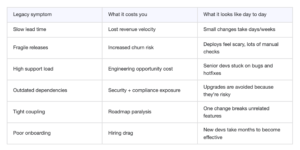
A quick way to quantify legacy risk
Use this simple table to turn “we should modernize someday” into a clearer business case.
Why “we’ll rewrite it later” often makes it worse
Deferring modernization usually increases scope because:
- you keep adding features on unstable foundations
- more data gets trapped in old models
- more integrations depend on legacy behavior
- the cost of change keeps rising
That’s why many successful teams shift from “big rewrite” thinking to a staged approach: isolate risk, untangle the worst constraints first, and modernize in increments.
What to do instead: modernize without blowing up the business
Modernization doesn’t have to mean a dangerous, all-at-once rewrite. A pragmatic path often looks like this:
- Discovery and planning to map the real bottlenecks (technical and business).
- Targeted refactors where they unlock delivery speed (tests, boundaries, coupling).
- Incremental replacement of high-risk modules (behind stable interfaces).
- Integration cleanup so new systems can safely coexist.
- Ongoing maintenance so you don’t end up back here in two years
When it’s time to bring in outside help
You should consider an experienced modernization partner if:
- releases are slowing and nobody can explain why
- adding features increases bugs and regressions
- the system can’t support the next phase of growth (new market, new pricing model, new compliance requirements)
- integrations keep failing or require constant babysitting
- leadership is afraid of “touching” core areas
Talk to Delta Systems about your legacy codebase
If you want a clear modernization plan (not a vague “you should refactor”), Delta Systems offers a straightforward way to start: schedule a consultation or reach out directly.
- Contact our CEO for a brief 15-minute call about your project.
- Prefer email? Email us at sales@deltasystems.com
Modernizing legacy software isn’t just an engineering initiative. It’s a way to protect revenue, reduce risk, and get your product team moving again, without waiting for the day the “stable” system stops being stable.