Building a SaaS from scratch is a game of momentum. In the early days, the teams that win aren’t the ones with the most “future-proof” architecture on paper—they’re the ones that can ship, learn, and iterate before runway runs out.
That’s why Ruby on Rails still deserves a top spot for founders and product teams going from idea to paying customers. Rails helps you move fast without painting yourself into a corner, as long as you build with solid conventions and a clear scaling path.
The real job of a v1 SaaS is learning, not “scaling”
Your first version has one mission: validate a painful problem, prove demand, and find a repeatable way to deliver value.
At this stage, “speed” isn’t just developer convenience—it’s strategic advantage. Rails is designed for exactly this: compressing the time between an idea and a working feature, so you can put it in front of users quickly and improve it weekly (or daily).
Rails also encourages a straightforward structure (MVC, conventions, sensible defaults). That reduces decision fatigue and keeps early-stage codebases understandable—especially when you’re hiring your first engineers or working with an external dev partner.
Why Rails still works so well for SaaS MVPs
Rails isn’t trendy; it’s dependable. It’s also unusually good at packaging the “common SaaS work” into a predictable build process.
Most SaaS MVPs need the same building blocks:
- authentication and permissions
- emails and notifications
- CRUD + admin workflows
- background jobs
- file uploads
- clean REST patterns (or API mode)
Rails gives you a lot of this out of the box, plus a mature ecosystem for the rest. The practical result is fewer weeks lost to plumbing and more time spent on what makes your product different.
Convention over configuration helps small teams ship like big teams
Rails conventions remove hundreds of micro-decisions that slow teams down. That matters when you’re building with:
- a tiny engineering team
- a founder who also sells/supports
- a tight budget and tight deadlines
When your app follows Rails conventions, onboarding is faster, refactors are safer, and “where does this code go?” stops being a daily debate.
Rails fits common SaaS patterns naturally
SaaS products often require patterns like multi-tenancy, billing flows, role-based access, and internal admin tooling. Rails is a strong fit for these needs and keeps the code cohesive while the product is still evolving.
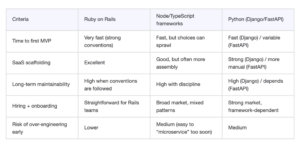
A practical comparison: Rails vs other common MVP stacks
The “best” stack depends on your team, but here’s a grounded way to think about Rails as a starting point.
Scaling Rails: What’s changed (and what hasn’t)
The old “Rails doesn’t scale” cliché usually comes from teams that scaled poor architecture, not Rails.
In practice, Rails can start as a clean monolith (ideal for MVP speed), then evolve as you grow—modularizing boundaries, extracting services only when the product has proven where the load and complexity truly are.
A healthy Rails scaling roadmap often looks like:
- Monolith MVP (fast shipping, clear domain model)
- Modular monolith (service objects, boundaries, internal engines where needed)
- Selective extraction (only split services when the data/latency/ownership demands it)
This approach lets you “pay for complexity” only when you’re actually earning it.
Where Rails projects go wrong (and how to avoid it)
Rails is fast, but it’s not magic. Most Rails failures come down to a few predictable mistakes:
Over-engineering too early
Microservices, exotic patterns, and premature abstractions can slow your MVP to a crawl. Keep the system simple until you have real usage data.
Fighting Rails conventions
Rails rewards consistency. If teams ignore conventions and scatter business logic everywhere, the app becomes hard to maintain and performance work gets messy.
Reinventing what already exists
Custom-building authentication, admin tooling, or billing from scratch is a common time sink. Rails has mature approaches and community-supported options—use them unless you have a clear reason not to.
From MVP to durable product: A Rails-first playbook
If you’re starting from zero, here’s a simple Rails-first approach that keeps you fast now and stable later:
- Validate the core workflow first (one user journey, end-to-end)
- Build the paid path early (even a basic Stripe flow, if relevant)
- Add admin tools before you add “more features” (ops speed matters)
- Instrument everything (errors, performance, key events)
- Harden after traction (caching, background jobs, query tuning)
This is how Rails becomes not just a “quick MVP framework,” but a foundation you can build on for years.
How Delta Systems helps teams launch faster with Rails
At Delta Systems, we build and modernize complex web applications—especially B2B SaaS—by embedding with teams and focusing on long-term product health, not just shipping tickets.
Rails is one of our core technologies, and we use it because it consistently delivers what SaaS teams need most:
- rapid development without chaos
- clear conventions that scale across teams
- a pragmatic path from MVP to mature platform
If you’re weighing Rails for your SaaS MVP (or wondering whether your current app needs a rewrite, performance work, or a more scalable structure), you can explore our perspective in Why Ruby on Rails is the smartest tech stack for your SaaS MVP and learn how real teams build in the wild on the SaaS That App podcast.